
Most visiting riders pack the bike away once the ski season starts. That is understandable but not strictly necessary. Queenstown in winter still has rideable trails, rideable days, and — if you know where to look and when to start — some of the best conditions the region offers. The catch is that winter does not forgive the habits that work in summer.
The Reality of Winter Riding Down Here
What Cold Actually Means at This Latitude
Queenstown winters are not Ruapehu or Wanaka cold, but they are cold enough to change everything about how you ride. The valley floor sits at around 310 metres and temperatures through June to August regularly drop to minus five overnight, with daytime highs between three and eight degrees on a clear day. Overcast days might not crack five. That sounds manageable until you factor in wind chill on a descent or the fact that frost lingers on shaded trail sections until well past ten in the morning.
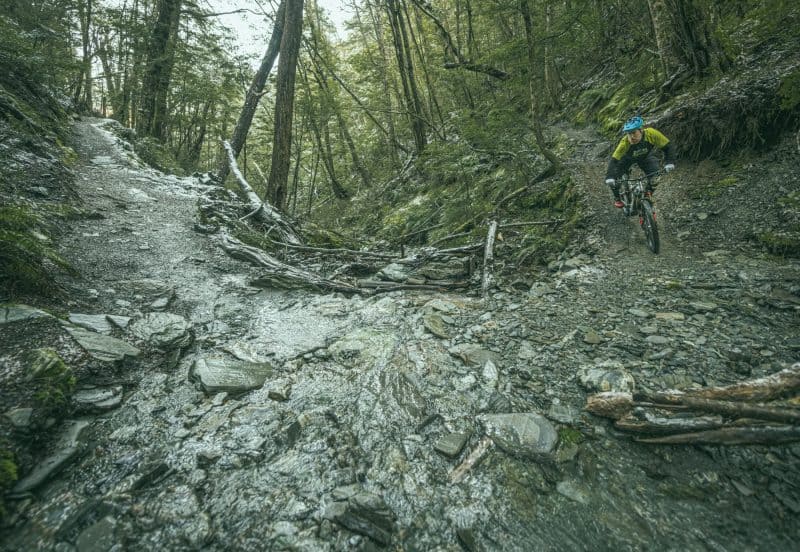
Ice is the real variable. A trail that was perfectly rideable yesterday afternoon can be a sheet of black ice at eight o’clock the next morning. Wooden boardwalks and bridges are the worst — they freeze first and thaw last. Schist rock, which is grippy in most conditions, becomes genuinely dangerous with a film of ice over it. You learn to read the surface differently in winter: that dark patch ahead might be moisture, or it might send you sideways without warning.
None of this makes winter unrideable. It makes it a different discipline. The riders who enjoy it most are the ones who stop expecting summer conditions and start treating winter as its own season with its own rules.
The Daylight Problem
The shortest day in late June gives Queenstown roughly eight and a half hours of daylight — sunrise around quarter past eight, sunset just after five. That sounds workable until you account for the mountains. The Remarkables block the morning sun from the eastern side of town until well after official sunrise, and the western ranges eat the afternoon light early. Depending on where you are riding, your actual sunlight window can be two hours shorter than the official figures suggest.
For practical purposes, the reliable riding window on most winter days is about 10am to 4pm. Start earlier and you are dealing with frozen trails and poor visibility in shadowed valleys. Push past four and the temperature drops fast — you lose five degrees in the last hour of light, and if you are already cold from a long ride, that is when mistakes happen.
Lights help, obviously, but they change the nature of the ride. The Queenstown Trail network handles headlamp riding well enough — the paths are wide and well-surfaced. Singletrack in the dark is a different proposition. Most locals who ride through winter carry lights as insurance rather than planning to use them.
When the Weather Cooperates
The Wakatipu Basin sits in a pattern of weather systems that makes winter less predictable than you might expect. The classic good day — clear sky, no wind, hard frost overnight turning to a crisp dry afternoon — comes in clusters. You might get three or four days in a row, then a northwest front rolls through and dumps warm rain that melts any snow down to the valley floor and turns trails to mud.
Southerlies are the other main player. A strong southerly pushes the snow level down from the alpine tops toward the valley. The day after a southerly is often spectacular — clear sky, fresh snow on the Remarkables, and cold dry air that keeps the trails firm. But the southerly itself is not a riding day unless you enjoy headwinds and horizontal sleet.
The practical skill is forecast reading. MetService mountain forecasts tell you more than the town forecast because they include snow level and freezing level, both of which matter if you are heading above the valley floor. A winter riding week in Queenstown might yield three or four genuinely good days. The rest are either too wet, too icy, or too short on daylight to justify getting kit on. That ratio improves markedly in late August as the days lengthen and the frost retreats.
Valley Floor Trails That Keep Going
The Queenstown Trail Network in Winter
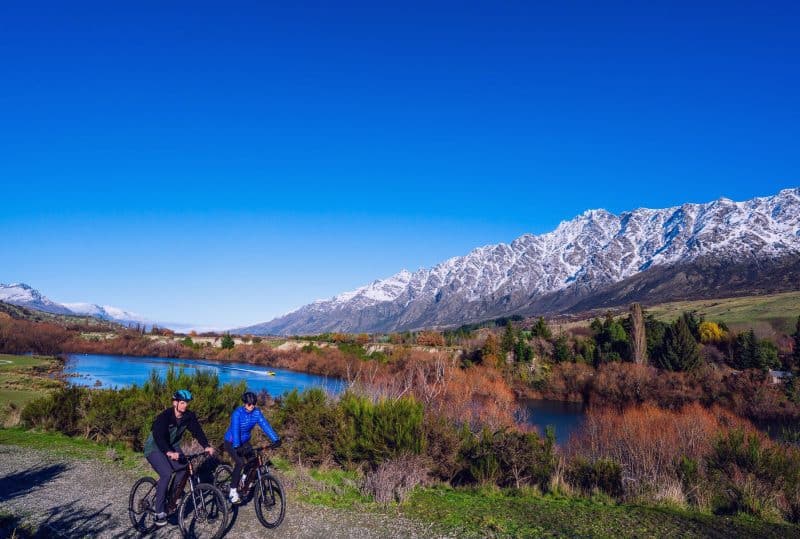
The Queenstown Trail network is the winter backbone. These are the trails that work regardless of what the weather has done overnight — sealed or well-compacted gravel surfaces, mostly flat, running through the valley floor between Queenstown, Frankton, Lake Hayes, and Arrowtown. The surface does not break down in wet conditions and frost clears from the open sections by mid-morning on most days.
The Frankton Track along the lake edge is the most popular winter commute and fitness loop. It catches the morning sun relatively early because it faces north across the lake, and the surface is sealed the entire way. The stretch from Queenstown Bay to the Hilton is sheltered from the prevailing winds by the terrain. On a clear winter morning, with the Remarkables covered in fresh snow across the lake, it is one of the better rides anywhere in the country.
The Lake Hayes loop adds distance and a change of scenery. The trail around the lake is well-maintained gravel that holds up through winter. The eastern side of the lake gets sun first, so if you are starting early, ride clockwise. The Arrowtown link trail from the far end of Lake Hayes is similarly solid — a wide gravel path through farmland that is rarely muddy enough to be a problem.
Kelvin Heights and the Sunshine Factor
Kelvin Heights is the local winter trick that does not show up in most riding guides. The peninsula juts south into the lake and its northern-facing slopes catch the sun from mid-morning onward, often a good hour before the rest of Queenstown thaws. On a clear day, the Kelvin Heights trails can be dry and frost-free by half past nine while the Gorge Road trails are still crunchy underfoot.
The lower tracks on the peninsula are moderate-grade singletrack through pine forest — nothing technical, but pleasant riding with lake views that justify the effort. The surface is largely compacted dirt and pine needle, which drains well and does not hold frost the way clay or grass does. There is a loop you can piece together using the Kelvin Peninsula Walkway and the lower mountain bike tracks that gives you a solid hour of riding without repeating any section.
The catch is access. The ride out from town to the peninsula adds about twenty minutes each way along the lakefront trail. In winter, that means leaving town at ten to be on the peninsula by half past, which still lands you inside the reliable daylight window. Most locals treat Kelvin Heights as the fallback option when the plan A trail is still frozen.
Mountain Bike Trails Worth the Cold
Gorge Road and the Lower Wynyard Trails
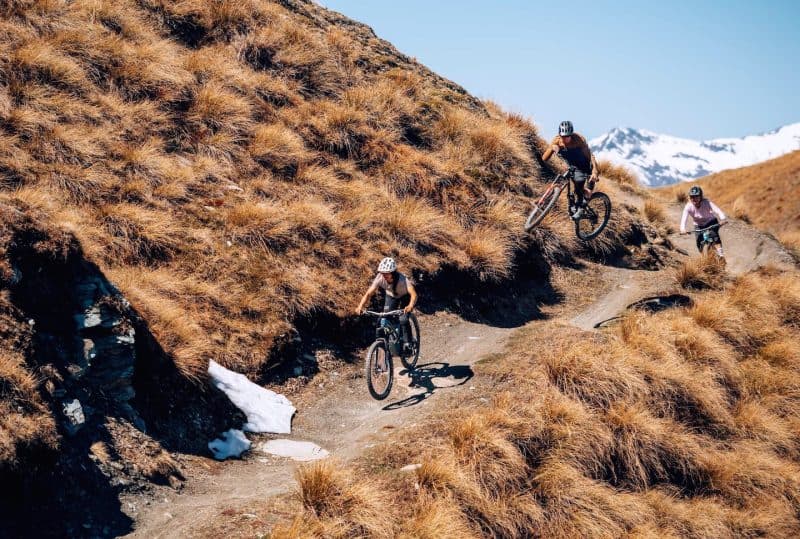
The lower trails in the Queenstown Bike Park and around the Gorge Road area sit below the tree line in relatively sheltered terrain. They do not get the worst of the frost and they thaw faster than anything at elevation. The Gorge Road jump park itself is hardpacked dirt that handles winter well — it freezes solid overnight but by late morning the surface has softened just enough to ride without being slippery.
The flow trails in the lower sections of the bike park — the green and blue runs accessed from the lower gondola station area — are rideable through most of winter if you time it right. The key is avoiding the morning ice. These trails have enough canopy cover that frost does not penetrate as deeply, but the flip side is that the canopy also blocks the sun, so melting takes longer. The sweet spot is usually between eleven and two when the trail surface is thawed but not yet saturated from meltwater.
Pedal access only — the gondola runs a reduced winter schedule and the bike park officially closes for the season. But the trails themselves are not gated and locals ride them year-round. Just be aware that no trail maintenance happens in winter, so expect the odd windfall branch or drainage washout that was not there in autumn.
Coronet Peak Access Road Climbs
The road up to Coronet Peak ski field is a sealed climb of around ten kilometres with roughly 600 metres of elevation gain. In winter, it is one of the most popular road cycling routes in the region — not despite the cold, but partly because of it. The climb generates enough body heat that all but the coldest days are manageable, and the summit views across to the Remarkables and down to the Wakatipu are reward enough.
The gradient averages around six percent with a couple of steeper pitches near the top. In winter conditions, the main risk is ice on the road surface, particularly on shaded corners in the lower section. The ski field access road is generally well maintained and gritted for vehicle traffic, but early morning starts before the gritters have been through are genuinely dangerous. Midday is the safest window.
The descent is where winter bites. After twenty or thirty minutes of climbing effort, you are warm. Then you turn around and face a ten-kilometre descent in sub-zero air at speeds that add serious wind chill. Experienced winter riders carry a wind shell specifically for the descent. The alternative is arriving at the bottom with hands too cold to brake properly, which on a road shared with ski traffic is not a position you want to be in.
Arrowtown: the Sheltered Option
Arrowtown sits in its own microclimate — a basin within the larger Wakatipu Basin, sheltered from the worst of the prevailing winds by the hills to the north and west. That shelter makes it noticeably warmer than Queenstown on calm winter days, though the frost can also settle deeper in the still air and linger longer.
The trails around town suit winter riding because most of them are low-grade and well-surfaced. Tobins Track is the standout — a grade three climb from the edge of town up through tussock and schist to a viewpoint over the Arrow Basin. The schist surface handles frost well once it clears; the rock has enough texture to grip even when damp. The main thing to watch is the first hour of sunlight on the exposed sections, where frost can sit on the rock face like a glaze.
The Bush Creek trails along the Arrow River are flatter and more sheltered. Pine forest keeps the worst of the frost off the trail surface, and the compacted gravel path holds up through winter without turning to mud. For an easy winter spin, the river trail from town to the historic Chinese settlement and back gives you about an hour of relaxed riding with minimal exposure to the cold. Combine it with a coffee stop in the main street and you have the most civilised winter ride in the region.
Gear That Actually Matters
Hands and Feet First
Cold extremities end winter rides earlier than fitness or motivation ever will. Your core stays warm from the effort of pedalling, but your hands and feet are just along for the ride — exposed to wind and vibration with minimal blood flow to keep them warm. Below zero, standard cycling gloves are useless within twenty minutes.
Lobster gloves — the split-finger design that groups your index and middle fingers together, ring and pinky together — are the best compromise between warmth and bar feel. Full mittens are warmer but you lose brake lever control, which is not a trade-off worth making on technical trails. Pogies, the handlebar-mounted shells that your hands sit inside, are popular with the commuters who ride the Queenstown Trail daily. They look odd but they work.
Feet are harder. Cycling shoes are designed to ventilate, which is the opposite of what you want at minus three. Neoprene overshoes are the baseline. Serious winter riders switch to flat pedals with insulated boots for anything below zero — the loss of pedalling efficiency is worth being able to feel your toes at the end of the ride. Merino socks underneath, always. Cotton is a misery generator in the cold.
Tyre Pressure and Brake Adjustments
Your bike needs adjustments for winter that go beyond what you ride in summer. Tyre pressure is the big one. Drop five to ten PSI from your usual setting. The softer tyre conforms better to frozen or loose surfaces and gives you more grip in corners where a summer-pressure tyre would slide. On icy sections, lower pressure spreads the contact patch and can be the difference between staying upright and not.
Disc brakes are non-negotiable. Rim brakes in frosty conditions are unreliable at best and dangerous at worst — moisture on the rim surface reduces braking power dramatically and it takes several rotations for the pads to clear the ice and bite properly. If your winter bike is still running rim brakes, that is the upgrade to prioritise before anything else.
Mudguards seem like a minor detail until you ride through a thawing puddle at speed and cop a rooster tail of icy water up your back. A rear mudguard at minimum, front as well if your fork has the clearance. Your drivetrain also takes a beating in winter. Grit, salt from road gritting, and the constant wet-dry-freeze cycle eat chains and cassettes faster than a full summer of dust. Clean and lube after every ride, not every week. Winter is when neglected drivetrains die.
Planning a Winter Ride
Timing Your Start
The single most useful winter riding habit is patience. Wait for the frost to clear before you start. This sounds obvious, but the temptation to get out early — especially on a clear morning when the sky is blue and the mountains look perfect — leads to more abandoned rides and more crashes than anything else.
On the valley floor, frost typically clears between ten and eleven on a sunny day. North-facing trails clear first; south-facing sections can hold ice until early afternoon. The Queenstown Trail network is generally safe from half past ten onward. Singletrack takes longer because the canopy blocks direct sun. If you are heading for Gorge Road or the lower bike park trails, eleven is a realistic start time.
The smart move is to let the forecast dictate not just whether you ride but when. A clear high-pressure day with light winds means you can start earlier and ride longer. A day with low cloud and no direct sun means frost will sit all day on shaded trails, so stick to the valley floor paths. Late August and early September are the transition weeks — the days are noticeably longer, the frosts are lighter, and the riding window expands from four hours back toward six.
The Forecast Tools That Work
MetService is the starting point and for most winter riding decisions it is sufficient. The mountain forecast for the Queenstown Lakes district gives you snow level, freezing level, wind speed and direction at altitude, and precipitation — all of which matter more than the town forecast when you are trying to decide between a valley ride and something with elevation.
The Remarkables and Coronet Peak webcams are free and updated frequently. They show you the actual snow level, which can differ from the forecast by several hundred metres in either direction. If the webcam shows snow down to the base building, your alpine trail options are gone for the day. If the snow line is well above the ridgeline, you have more room to move.
Local knowledge fills the gaps that forecasts miss. The Shotover River bridge on the highway to Arrowtown is a reliable frost indicator — if the bridge deck is white at nine in the morning, the trails will not be thawed until at least eleven. The temperature reading at Queenstown Airport, available online, tells you the valley floor minimum. Below minus three overnight and you are looking at a late-clearing frost. Above zero and you might be riding by nine. These small data points save you from driving to a trailhead only to find the trail is a skating rink.
Winter riding in Queenstown is not something you stumble into successfully. It rewards the rider who checks the forecast, waits for the frost, picks the right trail for the conditions, and carries a wind shell for the way home. The days are short, the windows are narrow, and the margins are thinner than any other season. But a clear July afternoon on the Frankton Track, with snow on the Remarkables and nobody else on the trail, is hard to beat for quiet satisfaction.