
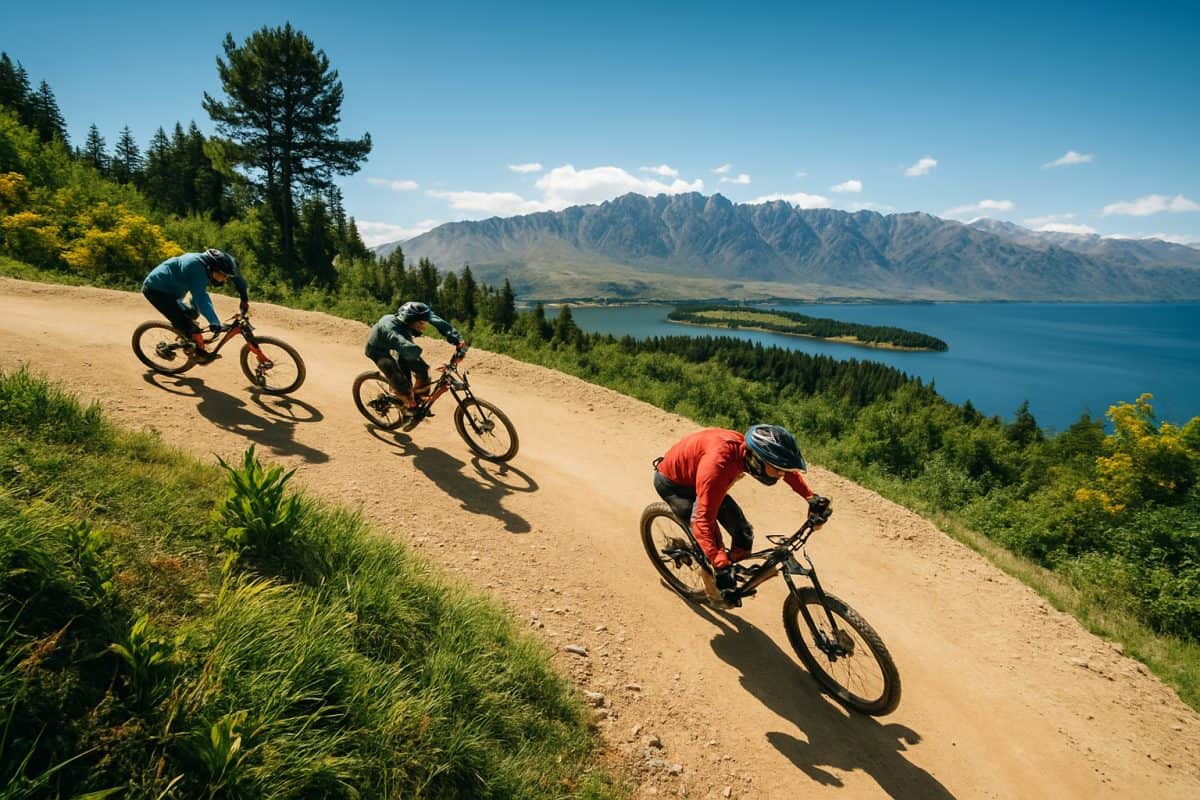
Skyline Queenstown Bike Park gets a lot of coverage from visiting riders and tourism websites, most of it accurate in the broad strokes and misleading in the details. The trails are good. The views are absurd. The price is significant. What the marketing material does not tell you is when to go, what to expect on each grade of trail, and how the park actually rides across a full season. We ride Skyline regularly and this is the version we give friends when they visit.
Getting Up There
The Gondola and How It Works for Bikes
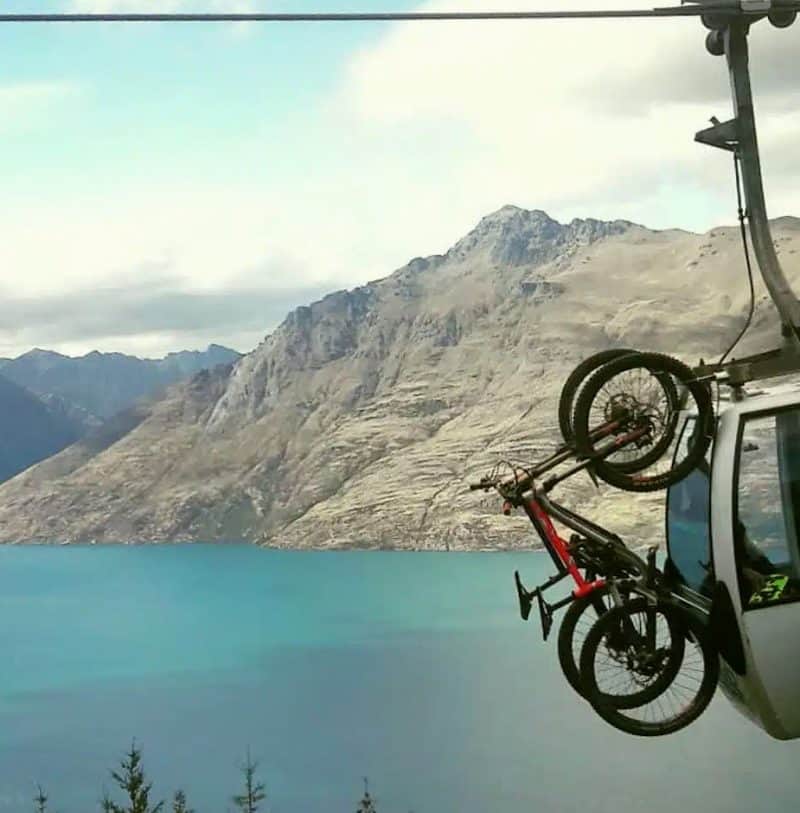
The Skyline gondola takes bikes in purpose-built external racks that attach to the outside of the cabin. Each cabin carries two bikes, mounted vertically by the front wheel. The loading crew handles the mounting — you hand your bike over, step into the cabin, and collect it at the top. The system works well once you are used to it, but the first time can feel rushed if the queue is moving fast. Have your seat dropped and any loose items secured before you reach the front of the line.
During peak periods — mid-December through February, and school holidays — the bike queue operates separately from the tourist queue. Wait times in peak season can hit thirty to forty minutes on a Saturday morning. By mid-afternoon that drops to ten or less. On weekdays outside of school holidays, you will rarely wait more than five minutes.
The key logistical detail is that you cannot take your bike up on the gondola without a bike park pass. There is no option to buy a regular gondola ticket and just ride down. The pass includes gondola access, trail use, and mandatory helmet. You can hire full-face helmets and body armour at the base if you do not carry your own.
Season Dates and Pricing
The Skyline Bike Park typically opens in late November and runs through to early April, though the exact dates shift each year depending on trail conditions and weather. The season has shortened slightly over the past few years as the operation adjusts its schedule around demand and maintenance needs.
Day passes sit around the ninety to one hundred dollar mark for an adult, which buys you unlimited gondola laps from opening to close. Half-day passes are available from mid-afternoon at a reduced rate and are worth considering if you only want a few runs. Season passes cost roughly five to six times a day pass, which means you break even at around six days of riding.
For locals, the season pass changes the economics entirely. You can justify a two-run after-work session or a quick morning lap before the day gets busy. For visitors, the day pass is a significant spend on top of travel and accommodation costs. The shoulder season offers the best value proposition — early December and late March have shorter queues, better trail conditions, and sometimes promotional pricing. Booking online in advance typically saves ten to fifteen percent on the gate price.
The Trails From Top to Bottom
The Learner Loop and Green Runs
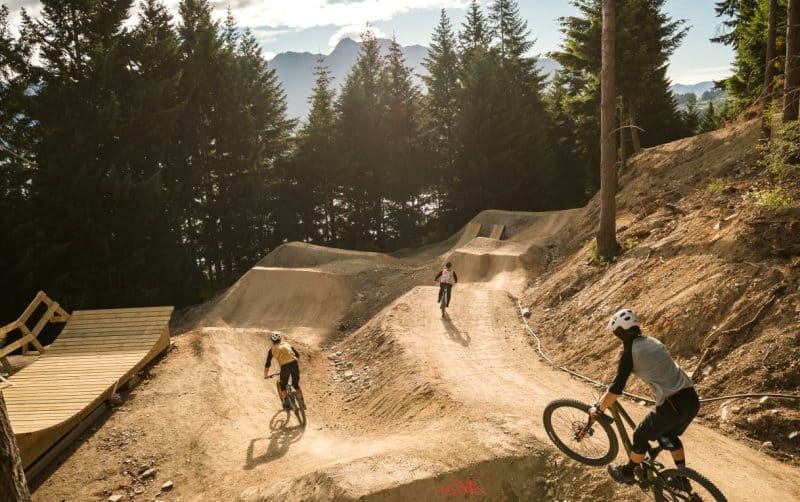
The learner loop near the top gondola station is a short, wide circuit designed for riders who have never been on a mountain bike trail before. It is flat enough that gravity does minimal work, which means you are pedalling around a set of gentle berms and rollers at whatever speed feels comfortable. For complete beginners, this is a useful space to get a feel for the bike and the terrain before committing to a descent.
The green-graded runs that descend toward the base are a meaningful step up from the learner loop. They are graded green by bike park standards, which is not the same as green by cross-country trail standards. The gradients are real, the berms have speed, and there are features — small rollers, tabletop jumps with ride-arounds, bermed corners — that require active riding. A fit rider who is comfortable on a mountain bike but has no gravity experience will manage. A true beginner who has only ridden on flat paths may find the green runs faster and steeper than expected.
The honest assessment: Skyline’s green trails are well built and well maintained, but they are bike park trails. They reward riders who can look ahead, control speed with brakes, and commit to corners. If that sounds like you, they are excellent. If you are not sure, start on the learner loop and work up.
Blue Trails: Where Most Riders Spend Their Day
The blue-graded trails are where the bike park comes alive. These are the runs that most riders lap repeatedly, and they range from smooth flow trails with predictable rhythm to more technical lines with rock features and steeper pitches. The spread across the blue category is wide enough that you can spend an entire season progressing through them.
The flow trails are the crowd favourites. Bermed corners linked by rollers, jumps with generous transitions, and a rhythm that rewards commitment. Once you find the speed, these trails carry you — pump through the rollers, let the berms do the turning, and the whole run flows like a single continuous movement. The jump lines on the blues have options: every feature has a ride-around or a smaller alternative, so you can lap the same trail at different intensity levels.
The more technical blues introduce natural rock features, off-camber sections, and steeper gradients that demand better bike positioning. These trails separate the riders who are comfortable at speed from the riders who can handle variable terrain at speed. The progression from easy blue to hard blue is where most riders see the biggest jumps in ability, and it is where the bike park earns its reputation as a place that genuinely develops riders rather than just entertaining them.
The Runs That Earn the Reputation
Hammy’s Track and the Black Runs
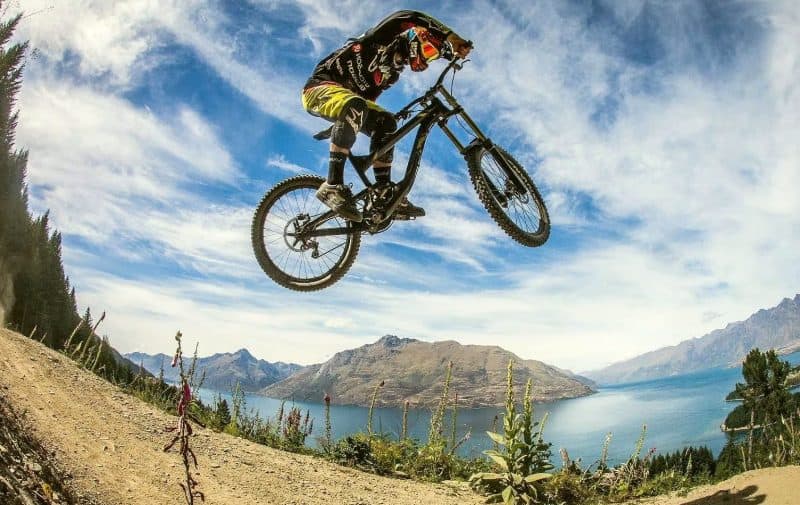
Hammy’s Track is the trail that most Skyline regulars eventually point visiting riders toward — half as a recommendation, half as a test. It is graded black and the grading is honest. The trail drops through exposed schist rock, with natural features that were shaped rather than built. The rock gardens are genuine — not decorative boulders placed beside a smooth line, but sections where the rock is the trail and you pick a line through it or you do not ride it.
The steep sections on Hammy’s demand commitment. The gradient is enough that hesitation mid-line puts you in trouble — your weight shifts back, the front wheel lifts, and the bike starts making decisions for you. Experienced riders drop their heels, shift forward, and let the bike roll through. First-timers on the trail often end up walking sections they could ride if they trusted the process.
The other black runs share similar characteristics: steeper, more exposed, less margin for error. The built features are bigger, the natural features are rougher, and the consequence of a mistake is a longer slide or a harder landing. These trails are not dangerous if you ride within your ability, but they punish overconfidence faster than anything on the blue network.
Vertigo and the Expert Lines
Vertigo and the double-black lines exist in a different category from the rest of the bike park. These are the trails that the park builds for riders who have outgrown everything else on the mountain, and they are not shy about the difficulty.
The drops on the expert lines are large enough that you need to actively generate speed on approach, commit to the takeoff, and manage the landing on a steep slope. The rock gardens are steeper and more sustained than anything on the blacks. Some sections are narrow enough that your handlebars are close to the rock walls on either side. There is no room for a correction — you are on the line or you are off the bike.
The park crew who maintain these trails ride at a level that makes the features look casual. Visiting riders who watch the locals session Vertigo and think it looks manageable are often the ones who end up in the medical centre. The honest advice is to watch a full run before committing, and to walk any feature you are not completely confident about. There is no shame in walking a double-black line. There is significant pain in misjudging one.
Timing and Tactics
Beating the Queues
The simplest way to beat the queues is to be on the gondola when it opens. The first hour of operation is almost always the quietest — the holiday crowd is still having breakfast and the bus tours have not yet arrived. You get three or four runs in before the queue builds, and by the time it peaks around eleven, you have already had a productive session.
The second window is mid-afternoon, between two and four. The morning crowd has exhausted themselves or moved on to other activities, and the late-afternoon riders have not yet arrived. This window is particularly good in January and February when the long daylight means the park stays open until six or later.
Weekdays outside of school holidays are consistently quieter than weekends. If you have flexibility, a Tuesday or Wednesday session in February is a different experience from a Saturday in January. The trails are emptier, the gondola wait is negligible, and you can session specific features without holding up a queue behind you. School holidays — two weeks in early January, two weeks over Easter — are the peak within the peak. If you can avoid those fortnights, do.
How Conditions Change Through the Season
The bike park goes through a predictable arc each season and knowing where you are in that arc helps set expectations. Early season — late November into December — the trails are freshly maintained. The crew spends the weeks before opening reshaping berms, rebuilding jump faces, and clearing drainage. The surface is soft and forgiving, which is great for confidence but means braking bumps develop quickly on popular lines.
Mid-season — January and February — is peak condition. The trails have bedded in. The surface has compacted from traffic and weathering into a firm, predictable base. Berms have developed a polished inside line. Jump transitions are dialled. This is when the trails ride best, and it coincides with the busiest period.
Late season — March and into early April — the trails show wear. Braking bumps on steep sections become pronounced. Dust builds on the schist surfaces, making them looser and sketchier. Some jump landings develop craters from thousands of impacts. The park crew maintains throughout the season, but by March the accumulated traffic has changed the character of the more popular runs. Late season is still excellent riding, but it rewards a slightly different approach — smoother inputs, lighter braking, and an acceptance that the trail will feel different from the groomed early-season version.
The Things They Do Not Tell You
The Wind Factor
Bob’s Peak sits at around 790 metres and the gondola station is exposed to weather that Queenstown’s lakefront, 400 metres below, never sees. The nor’wester is the main issue. When a nor’west wind is blowing at fifteen to twenty knots in town, it can be gusting thirty to forty knots at the top of the bike park. That turns exposed trail sections into a genuinely unpleasant experience — dust in your face, crosswinds pushing you offline on berms, and the psychological drain of riding into a headwind on what is supposed to be a downhill run.
The gondola itself slows or closes in strong wind conditions as managed by Skyline. If the gondola is running at reduced speed, the wait times increase and your laps-per-hour calculation falls apart. If it closes, you are walking down or waiting it out at the top station cafe.
Before buying a pass, check the wind forecast for Queenstown. The MetService mountain forecast gives wind speed and direction at altitude, which is more relevant than the town forecast. If the forecast shows northwest winds above 30 km/h, expect conditions at the top to be marginal. Above 40 km/h, reconsider your plan.
The Fitness Surprise
The marketing says gondola-assisted and the brain hears no pedalling. The reality is more nuanced. The gondola takes you to the top of the hill, but the trails do not all start at the gondola station door. There are linking sections between the top station and the trail heads, and between trail exits and the bottom loading area. These are short but they add up over a full day.
More significantly, the trails themselves are not uniformly downhill. Some blue and black runs have short uphill sections where the trail traverses the hill before the next descent. These are not long climbs, but after your sixth or seventh run, when your legs are already fatigued from braking and cornering, a fifty-metre uphill grunt feels disproportionately hard.
The altitude plays a role too. The top station sits at 790 metres — not alpine by any stretch, but enough above the valley floor that visitors from sea level sometimes notice the difference in their breathing on the first few runs. Bring more water than you think you need. Bring food for a full day. The cafe at the top station sells food and coffee, but the prices reflect the gondola-access-only location. Most regulars carry a pack with water, snacks, and a spare tube, and pace their runs with breaks rather than trying to max out their laps per hour.
Is It Worth It
The Season Pass Calculation
The season pass pays for itself at around six days of riding. For a local rider who lives in Queenstown and can duck up for after-work laps or a quick weekend session, six days across a four-month season is a low bar. Most season pass holders ride significantly more than that.
The real value is not in the per-ride economics. It is in the freedom to ride casually. With a day pass, you feel compelled to maximise your laps because you have paid ninety-odd dollars and you want your money’s worth. With a season pass, you can ride two runs on a Wednesday evening, decide the wind is too strong, and go home without feeling like you wasted anything. You can show up at three in the afternoon for a single lap because conditions are perfect. That flexibility changes the relationship with the park from a day out to a regular part of your riding week.
The season pass also typically includes benefits — early access to the park before public opening on certain days, discounts at the base shop, and sometimes guest pass options for visiting friends. The specifics change each year, so check the Skyline Queenstown website for current pricing and inclusions.
Honest Comparison With Other Options
Skyline is not the only downhill riding option in the Wakatipu. The trails in the Wynyard area above town offer genuine singletrack with technical challenge, and they are free. The Gorge Road jump park is free. Shuttle runs on the Coronet Peak road give you gravity riding with zero infrastructure cost. The question is not whether Skyline is good — it is — but whether it is the best use of your riding time and budget.
For a visiting rider with three days in Queenstown, we would suggest one day at Skyline and two days on the free trails. Skyline gives you the bike park experience — maintained jumps, groomed berms, gondola laps, and the buzz of a shared riding space. The free trails give you something Skyline cannot: longer descents, natural terrain, quiet singletrack through bush, and the sense of riding in the landscape rather than on a course above it.
For locals, the comparison is less meaningful because you can ride both. Skyline after work on a Tuesday, Wynyard on a Saturday morning, Gorge Road whenever the mood strikes. The season pass makes Skyline a complement to the free trails rather than an alternative. The riders who get the most from the Wakatipu are the ones who treat the whole network as a menu rather than picking one item and sticking with it.
Skyline is a well-built bike park in a spectacular location, run by people who understand that mountain bikers are a different audience from sightseeing tourists. It is not perfect — the wind exposure, the price, the queues in peak season are all real — but on a calm January afternoon with bedded-in trails and short gondola waits, there are very few places in the country that offer a better hour of riding. Treat it as one part of the Queenstown riding picture, not the whole thing, and it delivers.